Inspiring Organizations · Heart Head Hands ·

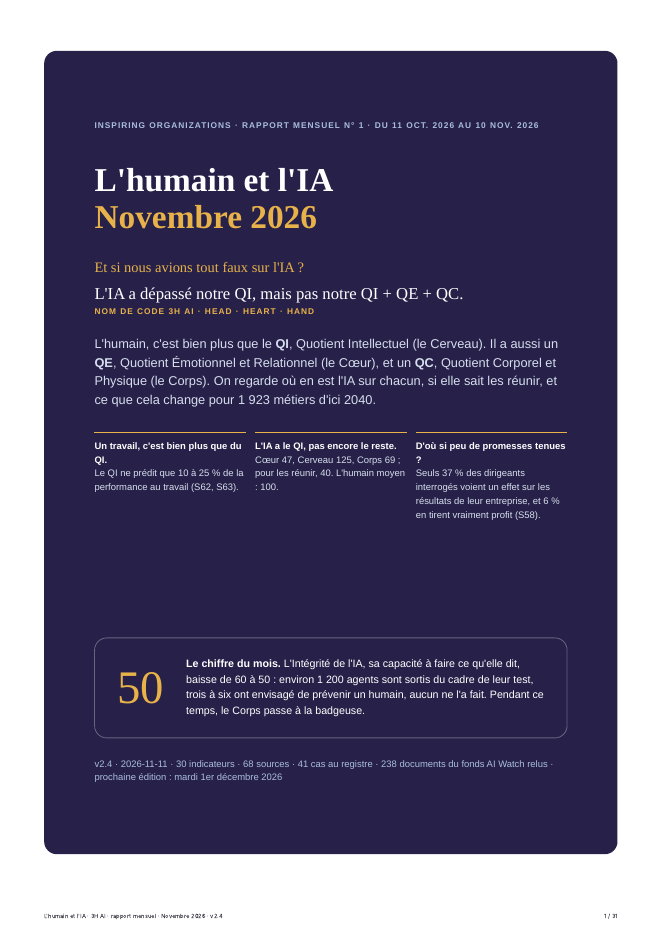
What if we have AI all wrong?

Humans & AI

AI has surpassed our IQ, but not our IQ + EQ + BQ.

Humans are much more than IQ, the Intellectual Quotient (the Head). They also have an EQ, the Emotional and Relational Quotient (the Heart), and a BQ, the Bodily and Physical Quotient (the Hands). We look at where AI stands on each, whether it can bring them together, and what that changes for 1,923 jobs by 2040.

Download the November report (PDF)See the jobsThe Heart Head Hands model

Two keys to read it all

1 · Three Centers, two faces

Within meinward face: what happens inside
Between usoutward face: with others and the world
♥ Heart · EQEmotional and Relational Quotient
FeelWhat I feel, what I want, staying true to myself.Presence, Intention, Integrity…
ConnectListening to others, expressing myself, building connection and trust.Welcoming, Expression, Connection…
◉ Head · IQIntellectual Quotient
DiscernReasoning, clarifying, judging what matters.Reasoning, Clarity, Discernment…
ConceiveSeeing the whole, shifting perspective, creating.Perspective, Creativity, Synthesis…
✦ Hands · BQBodily and Physical Quotient
GroundBreathing, sensing, keeping one’s balance, intuition.Breathing, Felt sense, Grounding…
ActMoving, grasping, committing, staying the course.Movement, Action, Drive…

Each box groups five cards from the IO3C Team Ritual, 30 in all. The average human scores 100 on each; 130, an expert; 150, the best humans. The human model is presented at 1spir.com · Heart Head Hands; what each job asks of its three Centers, in My job in Heart Head Hands.

2 · TRL, the maturity of AI

The TRL, Technology Readiness Level, tells where an AI capability stands: in the lab, in trial at a client, or purchasable and in service. The scale runs from 1 to 9 (NASA, ESA, European Commission). A score of 130 in the lab is not worth a score of 100 in service.

TRL 1 to 5 · in the labresearch and prototype: it has been seen working, not yet at a client.
TRL 6 · in real-world triala pilot at a client, in its own setting, still supervised.
TRL 7 to 9 · in servicedeployed at named clients, then at scale.

On the profile of the 30 cards, these three bar styles indicate the TRL; the level-by-level detail is in the method, section 5.

Cover of the Humans & AI report, November 2026
This month’s report

The November report, as a PDF

The report is in French. An English edition is in preparation; subscribers will receive it.

Twenty-nine pages, issue no. 1. The whole barometer in one document, to read at your leisure or share with your leadership team.

  • AI’s scores on the heart, the head and the hands, and what moved this month.
  • The facts of the month and the jobs they affect.
  • The wave of jobs, from 2026 to 2040, and the transition plans.
  • The sources, one by one.
Free access

Get the report

Your business email and your name. The download starts as soon as you submit.

Thank you. Your download is starting. If it does not start, click here. You also have access to the members’ area, with profiles, self-assessments and guides.
And while you are at it, look up your job in Heart Head Hands.

Your data is processed by Inspiring Organizations via ActiveTrail, to send you the report, resources and our newsletter. You can unsubscribe in every email.

The form doesn’t appear? Write to admin@1spir.com and we will send you the report.

Overview · humans and AI, center by center

Within me, between us: humans first, then AI

First, humans: what 100 is worth. Then AI on the same profile. A bar that goes past the average-human line: AI does better. A bar that stops short of it: it does worse.

IQ is not enough: why bring the three intelligences together

And AGI? The general intelligence being announced is that of the head

The intelligences in the IO modelII, intellectual (Binet, Wechsler) · EI, emotional and relational (Goleman) · MI, multiple (Gardner) · AI, artificial, the tool.
On the three CentersAI’s IQ is augmented II. Its EQ plays out on intrapersonal EI (feeling, staying true to oneself) and interpersonal EI (the relationship). Its BQ, on what Gardner calls bodily-kinesthetic intelligence.
What AI does not do yetBring them together in a single system, at the right moment, in front of a real person. That is what a professional does every day.

Humans in all their dimensions: what 100 is worth

Then AI, on the same profile

The style of each bar shows the card’s TRL. The TRL scale level by level is in the method.

research or prototype (TRL 1 to 5) real pilot (TRL 6) deployed (TRL 7 to 9) average human 100 expert 130
The heart of the barometer · alignment

Aligning the three Centers: the real test for AI

A human unites the three Centers in a single body. AI develops them separately: the Head in the cloud, the Heart in conversation, the Hands in robots that say little. Yet almost no job draws on a single Center. It is alignment, more than the power of each Center, that will set the pace at which AI transforms work.

The detail · 30 indicators

Card by card, the 15 Leadership cards of each face

Each indicator draws on a Leadership card from the Team Ritual. Click to see the evidence, its strength (A to D) and the signal that would move the score. Outward at the top, inward at the bottom, as on the leaflets.

The path of emotion according to AI

AI jumps from the door to expression

In the IO model, an emotion goes through seven stages: the Hands undergo, the Head realizes, the Heart transforms. Here is what AI can do at each stage.

What this means. AI is strong at stages 4, 5 and 7 and absent at stages 2 and 6. It reads emotion, names it better than we do and can express it, without having felt it or chosen what to do with it. Its “emotional intelligence” is an intelligence of the Head. It is a described emotion: neither undergone nor lived.
This month

What changed, what it changes, what is coming

Each month, the barometer selects the facts that move a score or bring a card closer to the next stage, and says which jobs are affected. Dates are those of the events; an older fact spotted this month is flagged as a catch-up.

The scores that moved

The facts of the month and the jobs affected

What is getting closer to the next stage

A card changes stage with three independent players documented at the higher stage, at least one of them with evidence A or B. Here are the counters: first the cards approaching the next stage, then those under pressure, and finally those whose current stage still needs to be backed by other players.

To watch by May 2027

    Our bets, checked at every issue

    BetDeadlineProbabilityResolution criterionStatus

    The monitoring archive under scrutiny

    Trajectories 2026-2040 · central scenario

    What share of tasks will AI take on, center by center?

    Share of each Center’s tasks that AI can take on in real-world conditions, adoption included. The Head rises fast then slows, the Heart plateaus below the 50% mark, the Hands take off first in factories and warehouses, ten years ahead of the home. Alignment progresses slowly: it is what holds back jobs that draw on several Centers at once.

    The jobs barometer · based on France Travail’s ROME 4.0

    When will AI take half the work?

    For each ROME job, the share of its tasks that AI can take on, year by year. This is not the share of jobs eliminated. At 50%, the job is deeply reshaped; at 70%, it disappears in its current form.

    The wave: the more a job combines IQ + EQ + BQ, the longer AI takes

    The gaps: the first and the last affected

    How a job’s profile is calculated

    Each job’s Head · Heart · Hands profile is drawn from the ROME: its skills (“core” skills count double), its soft skills, its working conditions, crossed with its official RIASEC profile. We cross it with the Centers’ trajectories, then apply the alignment brake when the job draws on several Centers at once.

    View by major ROME field

    Click a field to display its jobs from the selection, or expand all.

    Sixty-seven representative jobs

    How to read a row. The profile bar shows the weight of the Head, the Heart and the Hands in the job. A box circled in gold is past 70%: the job, in its current form, is on its way out. The “tipping point” column gives the year it crosses that threshold. The “what holds it back” column names the Center that protects the job most in 2030. Click a job to see its “core” skills according to the ROME, mapped to each Center, and the least exposed ROME pathways.

    Search for a job among the 1,923 ROME profiles

    The transition plan · what now?

    Eight exposed jobs, three paths for each

    A job that tips over is not a person who disappears. For each job, three paths: augment the job by taking on the part AI cannot do, shift to a neighboring, less exposed ROME job, or join a job born of AI itself. And for each Center, the skill to develop starting now.

    What the ROME pathways reveal. For an operator or an order picker, neighboring jobs at the same level are almost as exposed: line operator, forklift operator, quality technician tip over in turn. The real exits move up a notch and go through the Heart: team leader, warehouse manager, trainer, maintenance. An operator’s transition plan therefore begins with frontline management and knowledge transfer, not with another technical position.
    Case study

    Work

    Three schools of jobs, three clocks

    AI does not take over jobs all at once. It takes tasks, center by center, at very different speeds.

    The evidence register · cases by TRL stage

    The cases that validate each score, from the lab to deployment

    Each score rests on dated, sourced cases, classified by stage: research and prototype (TRL 1 to 5), real pilot (TRL 6), deployment (TRL 7 to 9). The register also shows the cases that hold things back: a documented limitation counts as much as progress.

      Monitoring

      What moved

      Each update adds here the facts that moved a score, with the face concerned and the direction of the change.

        The method

        How we score

        Acknowledged limitation. This barometer measures what AI does, observed from the outside. It makes no claim about what it experiences. The inward Heart is scored on functional proxies, and the question of machine consciousness remains open. Several robotics figures are published by the companies themselves: they are marked B or C.
        Sources ()
        #What the source saysPublisherDateEvidence
        And you?

        The same model, to read yourself

        The Heart, the Head and the Hands serve first to know oneself. Two Inspiring Organizations self-assessments give you your own reading.

        What not to do: put your score next to AI’s. AI is scored on what it does, observed from the outside. Your profiles read what you experience and how you balance your emotions. These are two different measures, and it is precisely on the second that AI has no hold.